English
 español
 العربية

En la exportación y el comercio internacional de aires acondicionadosMuchos clientes pueden hacerse la siguiente pregunta: ¿Cuál es la diferencia entre los aires acondicionados de 50 Hz y 60 Hz? ¿Son compatibles?
En realidad, Hz (hercio) se refiere a la frecuencia de la red eléctrica. Cada país tiene frecuencias distintas, lo que influye directamente en el compresor, la velocidad del motor y el rendimiento general de los aires acondicionados. Esto es muy importante para los importadores y compradores de aires acondicionados.
La frecuencia de una red eléctrica se refiere al número de veces que la corriente alterna cambia por segundo.
50 Hz: Cambia 50 veces por segundo;
60 Hz: Cambia 60 veces por segundo.
Sencillamente, la corriente de 60 Hz cambia más rápido que la de 50 Hz.
En el mundo existen dos redes eléctricas principales:
Países con frecuencia de 50 Hz: China, Europa, Oriente Medio, África, Sudeste Asiático, etc.
Países con frecuencia de 60 Hz: Estados Unidos, Canadá, Japón, Corea del Sur, Filipinas, parte de Arabia Saudita, etc.
Básicamente, el compresor de un aire acondicionado es un equipo accionado por motor, y la frecuencia de la red eléctrica afectará directamente a la velocidad del motor.
La fórmula teórica para calcular la velocidad de un motor eléctrico es: Velocidad ≈ 120 × Frecuencia ÷ Número de polos. Por lo tanto, un motor de 60 Hz tiene una velocidad un 20 % mayor que uno de 50 Hz.
Una mayor velocidad del motor nos brindará una mejora en la capacidad de refrigeración, la potencia de refrigeración y el consumo de energía.
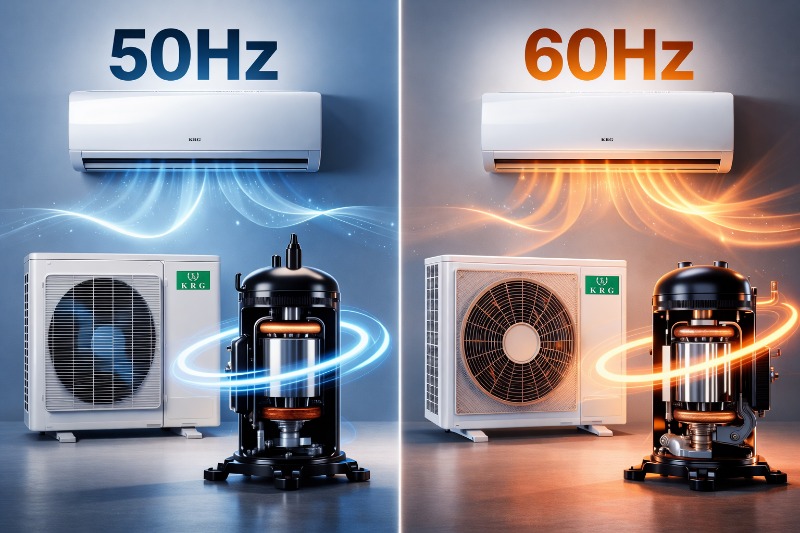
Un aire acondicionado de la misma capacidad, al cambiar su funcionamiento de 50 Hz a 60 Hz, verá incrementada su capacidad de refrigeración entre un 15 % y un 20 %.
Por ejemplo, la capacidad de enfriamiento de un Aire acondicionado de 12000 BTU:
A 50 Hz: alrededor de 12000 BTU;
A 60 Hz: alcanza 13500-14000 BTU.
En caso de aumentar la velocidad del compresor, la potencia de entrada también aumenta, al igual que la corriente.
Por lo tanto, el aire acondicionado de 60 Hz normalmente consume más electricidad durante su funcionamiento.
Tras el aumento de la velocidad del compresor y del motor, la vibración aumentará, y lo mismo ocurrirá con el ruido.
Pero esto no resulta obvio con la tecnología moderna de aire acondicionado.
Hay tres condiciones:
Si un aire acondicionado de 220 V y 50 Hz se conecta a una red eléctrica de 220 V y 60 Hz, puede provocar:
Exceso de velocidad del compresor;
Mayor corriente;
Se rompió tras un uso prolongado.
No se recomienda su uso a largo plazo.
En las mismas condiciones de voltaje, Aires acondicionados de 220 V y 60 Hz Puede funcionar en una red eléctrica de 220 V y 50 Hz, pero su rendimiento cambiará. La velocidad del motor disminuirá entre un 16 % y un 20 %. Esta disminución puede provocar:
Disminución de la velocidad del compresor;
Disminución de la potencia de salida;
Menor carga para el motor.
Acondicionadores de aire modernos de frecuencia variable (aires acondicionados inverterLos aires acondicionados inverter incorporan circuitos rectificadores e inversores. Convierten la corriente alterna en corriente continua y, posteriormente, generan una nueva frecuencia de corriente alterna mediante un inversor. Muchos de ellos pueden funcionar a 50/60 Hz.
Por eso, muchos aires acondicionados ahora vienen etiquetados como de 50/60 Hz.
110V, 220V, 380V, 440V.
50 Hz, 60 Hz o 50/60 Hz.
1 fase, 2 fases.
Una marca completa normalmente indica 220–240 V / 1 Ph / 50 Hz.
La principal diferencia entre los aires acondicionados de 50 Hz y 60 Hz radica en la frecuencia de la red eléctrica, que afecta directamente a la velocidad del compresor y al rendimiento general.
Gracias al desarrollo de la tecnología inverter, cada vez más aires acondicionados se adaptan a una red eléctrica de doble frecuencia de 50/60 Hz. Esto facilita la exportación de los aires acondicionados.


Derechos de autor
@ 2026 APARATOS CO., LTD DE GUANGZHOU SOUXIN Reservados todos los derechos
.
 RED SOPORTADA

Hi! Click one of our members below to chat on