English
 español
 العربية

En algunos proyectos, los clientes pueden preguntar: "¿Por qué hay caídas en el acondicionador de aire¿Hay algún problema? En realidad, no es un problema, sino una buena señal de que el aire acondicionado funciona correctamente.
Este artículo explicará este fenómeno en detalle desde las perspectivas del mecanismo, el diseño estructural y las aplicaciones de ingeniería.
I. La esencia de la condensación: el agua "extraída" del aire.
Siempre hay vapor de agua (humedad) en el aire. Cuando el aire acondicionado está enfriando, la temperatura de la superficie del evaporador es inferior al punto de rocío del aire. Como resultado, el vapor de agua se convierte en líquido al entrar en contacto con el frío, se adhiere a las aletas del evaporador y finalmente se condensa formando gotas. Eso es lo que observamos: las gotas de condensación.
Es lo mismo que el agua que queda en la superficie de un vaso de Coca-Cola fría en verano.
II. Mecanismo clave: Punto de rocío
La clave para que los aires acondicionados produzcan condensación reside en un concepto físico: el punto de rocío.
Cuando la temperatura ambiente es de 30 ℃ con una humedad del 70 %, el punto de rocío puede situarse en 24 ℃. La temperatura de la superficie del evaporador suele estar entre 5 y 12 ℃, muy por debajo del punto de rocío, por lo que la condensación es inevitable.
III. ¿Cómo gestiona el sistema de aire acondicionado el agua de condensación?
En los aires acondicionados, la condensación no sale libremente; en cambio, se conecta, se conduce y se expulsa a través de un diseño completo.
1. Bandeja de drenaje
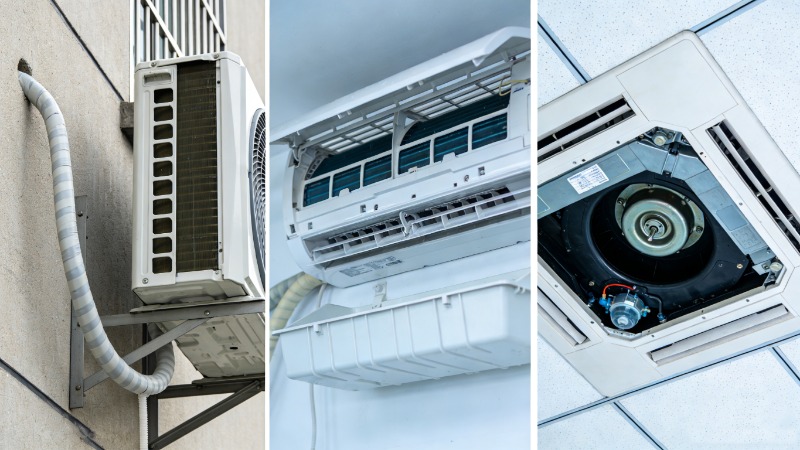
La bandeja de drenaje, ubicada justo debajo del evaporador y fabricada con materiales resistentes a la corrosión, cuenta con un diseño de ángulo deslizante que garantiza el flujo de agua hacia la salida. En algunos modelos de gama alta, la bandeja se rocía con pintura antibacteriana para evitar el moho y presenta una estructura de doble capa para prevenir la condensación secundaria.
2. Tubería de drenaje
Es el método natural de drenaje. Gracias a la gravedad y a una pendiente (≥1°), la condensación fluye naturalmente hacia la salida. Es económico y estable.
3. Bomba de condensado
Para las ocasiones en que la tubería de drenaje natural no puede funcionar, es necesaria una bomba de condensado incorporada. Se utiliza comúnmente en aires acondicionados de cassette de techo, aires acondicionados por conductosy algunos espacios comerciales. Ayuda a absorber el agua en la esquina o a un nivel bajo, bombearla a un nivel más alto o a través de una distancia, y finalmente evacuarla.
IV. ¿Cuándo es normal el "goteo"?
Las siguientes situaciones son normales en nuestra vida diaria:
Zonas de alta humedad (Sudeste Asiático, regiones costeras, temporada de lluvias, etc.);
El primer arranque del aire acondicionado.
Espacios concurridos (hoteles, salas de conferencias, centros comerciales, etc.).
Apertura frecuente de puertas y ventanas.
Cuanto mayor sea la cantidad de condensación, mejor será la capacidad de deshumidificación del aire acondicionado.
V. ¿Cuándo es anormal el "goteo"?
Ten en cuenta esas ocasiones:
Goteo directo desde la unidad interior;
Filtración de agua en la pared;
Fuga de agua en el aire acondicionado de cassette de techo.
Razones comunes:
Tubería de desagüe obstruida,
Pendiente de drenaje insuficiente,
Instalación incorrecta,
Mal funcionamiento de la bomba de drenaje,
Descongelación del evaporador tras la congelación.
Volviendo a la pregunta inicial: ¿Por qué se produce condensación en los aires acondicionados? La respuesta es bastante sencilla: porque funcionan eficazmente. La condensación es, en esencia, el resultado de dos funciones básicas del aire acondicionado: enfriar y deshumidificar. En ambientes con alta humedad, la condensación puede incluso servir como un indicador visual: a mayor cantidad de agua, mayor capacidad de deshumidificación.
Sin embargo, para proyectos de ingeniería y clientes B2B, otro aspecto crucial es la gestión de la condensación. El problema no es la condensación en sí, sino la condensación incontrolada. Un buen aire acondicionado no solo debe enfriar, sino también gestionar el agua.


Derechos de autor
@ 2026 APARATOS CO., LTD DE GUANGZHOU SOUXIN Reservados todos los derechos
.
 RED SOPORTADA

Hi! Click one of our members below to chat on