English
 español
 العربية

En verano la gente siempre dice que no hay que encender el... acondicionador de aire A una temperatura demasiado baja, consumirá más energía. ¿Por qué es cierta esta afirmación? ¿Consejo psicológico o una razón física real?
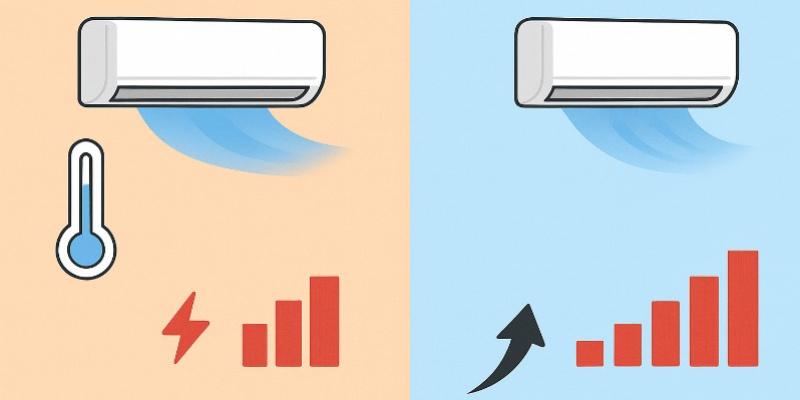
I. Cuanto menor sea la temperatura configurada, mayor será la diferencia de temperatura y mayor el consumo de energía.
La tarea principal del aire acondicionado es "transferir calor": transferir el calor del interior al exterior.
Establecer una temperatura de enfriamiento a 18℃ significa que el aire acondicionado necesita transferir más calor desde un ambiente más cálido al exterior.
Se relaciona con un concepto aquí: cuanto mayor sea la diferencia de temperatura (ΔT), más calor será necesario transferir y aumentará la potencia solicitada en cada unidad de refrigeración.
· Configurado a 26 ℃ con un ΔT pequeño, el aire acondicionado funciona cómodamente.
· Configurado a 18 ℃ con un ΔT grande, el aire acondicionado necesita una relación de compresión más alta para mantener el efecto de enfriamiento.
Cuanto mayor sea la diferencia de temperatura, más funcionará el aire acondicionado con una carga alta todo el tiempo y, entonces, el consumo de energía aumentará drásticamente.
II. A mayor relación de compresión, menor eficiencia energética.
El consumo de energía del compresor está relacionado con la relación de compresión.
Cuando la temperatura de ajuste disminuye:
· La temperatura de evaporación disminuye; el compresor necesita comprimir el refrigerante de baja presión a alta presión. Por lo tanto, el trabajo de compresión por unidad de masa de refrigerante aumenta significativamente.
· En particular, cuando la temperatura de ajuste es de 18 °C, mientras el compresor está funcionando a máxima velocidad o alta frecuencia, lo que resulta en una menor eficiencia y un mayor consumo de energía.
III. Mayor tiempo de funcionamiento para alcanzar la temperatura establecida y mayor consumo eléctrico.
La temperatura ambiente no cambia a 18℃ inmediatamente cuando hacemos clic en el botón, sino que debe disminuir de la temperatura común de manera constante.
Y tomará más tiempo alcanzar la temperatura designada si la habitación tiene un aislamiento deficiente, es de gran tamaño y tiene una carga térmica alta.
Durante el proceso, el compresor funcionará durante un tiempo prolongado bajo una alta carga, el flujo de aire interior se mantendrá alto y el sistema apenas alcanzará el nivel de baja frecuencia. Como resultado, el consumo de energía aumentará.
IV. A menor temperatura, mayor carga de deshumidificación.
El proceso de enfriamiento normalmente se acompaña de deshumidificación. Cuanto menor sea la temperatura, menor será la temperatura de la superficie de evaporación, mayor será el efecto de condensación y mayor será el calor potencial que el refrigerante debe absorber, ya que la evaporación de la humedad requiere energía. Esto implica una carga térmica adicional y un mayor consumo de energía.
V. Experiencia real: 26 ℃ es más ahorro de energía y más cómodo.
El frescor proviene no solo de la temperatura ambiente, sino también de la velocidad del viento, la humedad, la dirección del flujo de aire y la transferencia de calor corporal. Una temperatura demasiado baja puede no ser más cómoda; al contrario, provocará los siguientes problemas:
· gran diferencia de temperatura → se enfría fácilmente;
· temperatura excesivamente seca → piel incómoda;
· golpe de aire frío directo → dolor de cabeza y tensión en hombros y cuello.
El ajuste de temperatura más adecuado es 26 ℃ con velocidad de viento media y ligera humidificación, lo que ahorra energía y es cómodo.
VI. ¿Cómo mantener la misma temperatura con menos electricidad?
1. No configure la temperatura en el nivel más bajo al principio.
Primero configúrelo a 26 ℃, primero enfríe la habitación y luego ajuste la temperatura según nuestras sensaciones.
2. Trabajar con ventiladores, acelerar la circulación.
Mediante el cual el aire acondicionado puede reducir su nivel de enfriamiento y ahorrar más electricidad.
3. Evite los arranques frecuentes
En particular, en el caso de los acondicionadores de aire que no son inverter, reiniciar el aparato consumiría más electricidad.
4. Mantenga el filtro limpio
Los bloqueos en el filtro pueden provocar una mayor presión del sistema y un mayor consumo de energía.
5. Cierra la cortina y evita el calor.
Reduce la entrada de luz solar y reduce la carga térmica; como resultado, ahorra energía.


Derechos de autor
@ 2026 APARATOS CO., LTD DE GUANGZHOU SOUXIN Reservados todos los derechos
.
 RED SOPORTADA

Hi! Click one of our members below to chat on